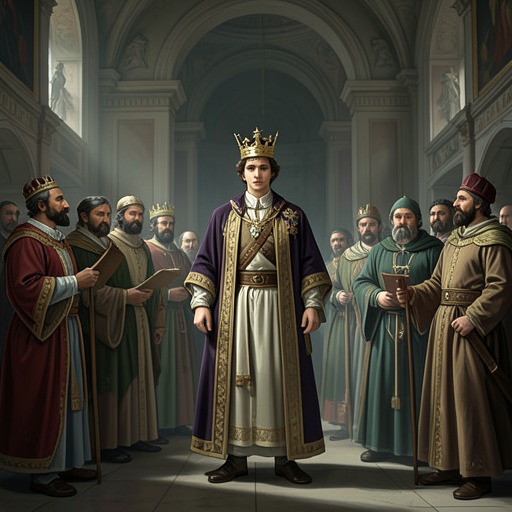
Death of Henry FitzRoy, Duke of Richmond and Somerset
The King's CurseThe death of Henry FitzRoy, Duke of Richmond and Somerset, is a personal catastrophe for Henry VIII and a crisis made more consequential by the absence of a surviving male heir. As the court travels, news of FitzRoy’s death reaches the king before it is announced to anyone else. His grief is overwhelming, but the response that follows is controlled by silence: the court continues its progress, postpones public mourning, and leaves the funeral to be arranged quietly. The event brings the king’s vulnerable private body into sharp contrast with the authority he claims as ruler.
The heir and the succession
Henry FitzRoy is the king’s son by Elizabeth Blount and is treated in the scene as Henry VIII’s surviving son and heir. His position gives his death a significance beyond the loss of a beloved child. Earlier, the possibility that Katherine of Aragon might give birth to a boy had carried hopes of securing the succession and changing the queen’s standing at court. The story also recalls a royal infant found lifeless in his cradle, another loss set against the dynasty’s need for a male successor. These earlier disappointments form the background to Henry VIII’s insistence that FitzRoy was his heir: the boy’s death renews, rather than resolves, the uncertainty surrounding the future of the Tudor line.
FitzRoy’s place in court had also been publicly celebrated. At a masque, Princess Mary Tudor drew the audience’s attention, while Henry VIII danced with Anne Boleyn; the queen watched the proceedings. The festivities show the court’s elaborate ceremonial world, but they also place the king’s changing personal attachments alongside the dynastic expectations attached to marriage and children. Against that setting, FitzRoy’s death makes the succession question immediate and intimate: the loss is not only a prince’s absence, but the disappearance of the son Henry VIII regards as his heir.
The news reaches the king
The disclosure comes during the court’s journey, as it follows Henry VIII toward an inn. A hard-ridden servant of Henry FitzRoy arrives from London, his exhausted horse marking the urgency of the message. Margaret Pole notices the disturbance and listens as the servant tells the waiting crowd that nothing could be done. She enters the inn and, seeing that the king has gone into a private room with the messenger, tells Montague that FitzRoy may be dead. She does not know the cause; the news is still incomplete, and the king has not yet emerged to confirm it.
Then the closed door gives way to the king’s anguished cry. Henry VIII’s reaction makes the news undeniable. Jane Seymour rises, but hesitates at the private-room door and cannot bring herself to enter. Margaret goes in instead. Henry has collapsed onto the floor, overcome with grief, and Margaret kneels beside him. When he cries that FitzRoy was his heir and the very image of himself, she answers gently that the boy was. Her response offers no political remedy; it acknowledges the bond Henry has lost.
Henry’s grief also turns toward explanation. He asks whether there is a curse against him and why he has lost those he loves, invoking Elizabeth Blount and FitzRoy as examples of people who, in his view, had done nothing to deserve such a loss. Margaret does not affirm his fear or challenge it. She remains with him, offering comfort while withholding a larger answer. In this moment, the king who commands the court is a bereaved father asking why his child has been taken from him.
A death the court cannot announce
The private scene is followed by an extraordinary public suspension. The king does not announce FitzRoy’s death. For three days the court remains at Sittingbourne, where messengers come and go, while the news gradually becomes known without being formally spoken. On the fourth day the court moves toward Dover. There is still no announcement, no court mourning, and no funeral plan. Everyone is expected to behave as though FitzRoy might yet arrive from London.
The delay is more than a pause in ceremony. Margaret sees the court’s obedience turning the king’s refusal to face his loss into a public fiction. The dead prince cannot return, but the court’s conduct leaves his absence officially unacknowledged. The episode connects household grief to political authority: when Henry VIII will not name a fact, his subjects are afraid to name it for him. The silence therefore reveals not only sorrow, but the power of the king’s wishes to govern what the court may publicly recognize.
The quiet burial and its consequences
Thomas Howard, FitzRoy’s father-in-law, eventually asks permission to leave court and bury him. He does not speak FitzRoy’s name in making the request. Henry VIII beckons him closer, whispers to him, and waves him away. Howard travels home to Norfolk; later, the court learns that he buried FitzRoy at Thetford Priory. Only two men attend the funeral, with a plain wooden coffin and a private service. The sparse arrangements contrast with the prince’s rank and with the scale of the grief Margaret witnessed in the king’s private room.
Margaret interprets the concealment as an effect of Henry VIII’s inability to bear another son’s loss, but also as a dangerous precedent. If the king can make the court act as though a death has not occurred, the same habits of silence may strengthen his ability to deny other unwelcome truths. FitzRoy’s death thus ends in both mourning and enforced non-acknowledgment: a father loses the son he calls his heir, while the court is made to conceal that loss. The event’s central contrast is between the king’s intensely human grief and the royal power that turns grief into a silence everyone else must observe.